
Overview
Designing an effective recommendation engine for a member platform – where members connect with other members, communities, or content – requires more than just data. It requires a deep understanding of member intent, platform scale, and how people discover value in real time.
At ScaleGrowth, we’ve built a recommendation system that works from day one and scales seamlessly – even for platforms with limited data or early-stage content.
In this guide, we’ll cover:
- What makes recommendation design unique for member platforms
- The three types of matching used in ScaleGrowth
- Why we run all three types in parallel by default
- How this supports both early growth and long-term scale
Why Recommendations Matter in Member Platforms
In member platforms, recommendations aren’t just about surfacing content – they’re about connecting people to the right value.
A strong recommendation engine helps members discover:
- Who might need support that I can offer?
- Which members or content align with my interests or goals?
- What opportunities or programs are most relevant to me right now?
The goal is to deliver personalized, high-signal suggestions – not just similar profiles or popular items.
To deliver this kind of personalized discovery, your system must understand:
- Who the member is (Profile)
- What the member is looking for (Preferences)
- What the member is doing or showing interest in (Behavior)
Challenges: Sparse Data and Limited Scale
Unlike global consumer platforms (e.g., LinkedIn, Netflix, TikTok), most member platforms have:
- Smaller user bases
- Limited content libraries
- Incomplete profile data
If we only relied on high-confidence, data-rich matches, most members would see zero recommendations – especially in the early days.
That’s why ScaleGrowth’s engine runs three distinct types of matching logic in parallel, by default.
This ensures that every member gets personalized recommendations, even if their data – or the platform’s – is still growing.
How ScaleGrowth’s Three-Tier Matching System Works
Our recommendation engine uses three types of matching, designed to work together, not in isolation. Each represents a different kind of signal: from direct, high-intent data to softer, behavior-based insights.
These types run in parallel, allowing your platform to provide meaningful, personalized suggestions – even when member data is incomplete or uneven.
🔶 Tier 1: Intent-Based Matching (Intent, Strongest Signal)
Think of this as the direct request layer – members get what they asked for.
It is the strongest, most intentional form of match. It aligns what a member says they want with what another member or content offers, using the same Tag Set or Smart Field across the Profile and Preferences views.
Examples:
- Member selects “Career Growth” in their Preferences and is matched with a program tagged “Career Growth.”
- A member offering guidance on “Leadership” in their Profile is matched with someone requesting help with “Leadership” in their Preferences.
Why this is helpful:
This is the classic “ask and you shall receive” experience. When members explicitly tell the system what they’re looking for, the platform returns exactly that. These matches feel clear, useful, and intentional – and are critical for creating trust in the recommendation engine.
💡 This type of matching is explicit and directional – and forms the core of high-quality, high-relevance recommendations.
🔷 Tier 2: Attribute-Based Matching (Explicit, Softer Signal)
This tier surfaces matches based on shared traits or interests, regardless of intent – such as two members having the same topic in their Profile or Preferences, or a member’s Profile matching the metadata of a piece of content.
Examples:
- Two members are both interested in “UX Design,” even if neither is offering or requesting it.
- A member who lists “Public Speaking” in their Profile is shown a webinar tagged with the same skill.
Why this is helpful:
This kind of match supports community-based discovery.
Let’s say you're looking for a job – finding others also job hunting in the same field can help you share resources, experiences, and tips. Similarly, if you're seeking a service provider (e.g. a therapist or coach), discovering others on the same journey lets you trade insights and recommendations – much like peer-review platforms such as Yelp or Reddit.
Tier 2 matches help members walk the journey together, even when they’re not offering or seeking something directly.
💡 Useful for surfacing peers, collaborators, or content with common ground – even if no one’s explicitly asking for a connection.
🧠 Tier 3: Behavior-Based Matching (Fuzzy & Inferred, Softest Signal)
This tier taps into the unspoken and behavioral signals, the most flexible and inferred form of matching collected from how members interact with the platform. It uses natural language, activity tracking, and collaborative filtering to recommend relevant content or members – even when structured field matches don’t exist.
Signals include:
- Shared phrases or keywords in bios, content, open text fields
- Browsing patterns (pages viewed, time spent, revisit frequency)
- Collaborative filtering (people similar to you liked this)
Examples:
- A member often reads content about “wellbeing,” even though they’ve never selected that tag. The system begins recommending more content in that theme.
- Members who share similar browsing behavior are shown content that their “lookalikes” found valuable – even if it's not explicitly tagged the same way.
Why this is helpful:
As the saying goes, “actions speak louder than words.”
Sometimes, what a person says they want isn’t what they truly need – or what they consistently engage with. Maybe a member says their favorite food is “ice cream,” but they order a salad for lunch every day. Behavior-Based Matching captures these deeper patterns.
This is the “how did they know?” layer – often the most magical and surprising form of personalization.
💡 This tier is essential for platforms with sparse data, enabling personalization even before profiles are fully filled out.
Why All Three Type Work Better Together
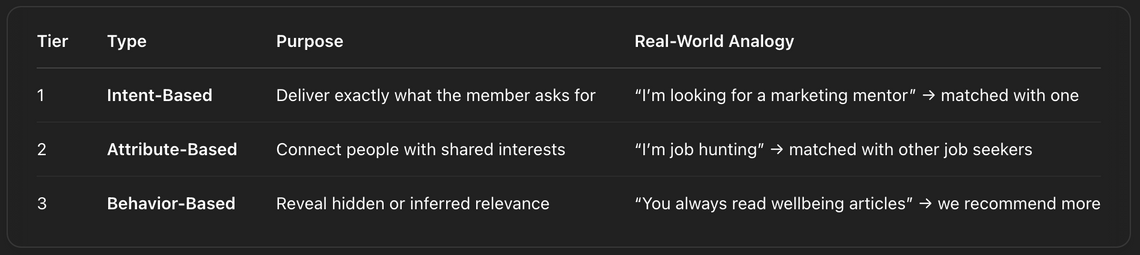
ScaleGrowth runs all three tiers of matching in parallel by default – and that’s intentional. They are complementary, not competitive:
- Intent-Based Matching delivers the exact results members explicitly ask for
- Attribute-Based Matching connects people through shared interests and journeys
- Behavior-Based Matching uncovers hidden signals and surprise relevance
Relying solely on high-intent matches can lead to empty recommendations, especially in smaller or newer communities. Members expect to see something – and getting no results often results in drop-off.
Platforms like LinkedIn, Facebook, and Netflix blend all three types.
They don’t only show you what you asked for – they also include:
- Similar content (Tier 2)
- Behaviorally relevant items (Tier 3)
This balance keeps feeds engaging, serendipitous, and sticky – which is essential for member retention and discovery.
This system ensures:
- Stronger matches appear at the top
- Weaker or fuzzy matches fill in the gaps
- Members stay engaged, even when data is incomplete
TL;DR: Matching Types in Action
Built to Support Every Stage
ScaleGrowth’s matching engine was designed with the full growth journey in mind:
- Early-stage platforms: Get high-coverage recommendations from Day 1, even with minimal content or members
- Growing platforms: Benefit from richer field matches as data becomes more complete
- Enterprise-scale platforms: Layer on advanced logic, hard filters, and personalization options
Final Thoughts
A recommendation engine should feel like a smart guide – not just a popularity algorithm. By combining intent, identity, and behavior, ScaleGrowth delivers human-centered recommendations that work now, and get smarter over time.
Related Articles
- Understanding Profile vs. Preferences Fields for Matching & Recommendations
- Using Saved Searches and Personalized Digests for Member-Centered Discovery
- Using Hard Filters for Custom Recommendation Logic (Enterprise Feature)
- How Tag Sets Work in Matching and Recommendations
- Using Platform-wide Tags
- Best practices for using Tag Sets
